

particular taste
how your favorite books change as you age

One of the greatest joys of getting older is that you get to watch yourself grow into a real person. I know I’m still young, that even as I approach thirty I’ve barely skimmed the surface of adulthood, but it’s difficult to appreciate that on a daily basis. You have to zoom out to remember that you’re just a tiny spec of dust on a giant planet in an even bigger universe.
And yet, I remember turning twenty thinking I was experienced. I remember being fifteen, writing novels about what it meant to be a person, as if I had ever really been alive. I felt like I knew who I was, what life meant, where I was going. And every few years, I am faced with the wretched realization that we are always changing and the world is unknowable no matter how much we will it otherwise.
“How can a person know everything at 18 but nothing at 22?”1
When I was sixteen, I remember an adult in my life telling me I wouldn’t have to spend my twenties figuring out who I am because I was so intensely myself as a teenager. At the time, I was buoyed by the compliment, thrilled that I was NOT LIKE OTHER GIRLS because I had things figured out. I didn’t have to waste time asking the universe WHO AM I! I already knew who I was, and surely that gave me a leg up in the world.
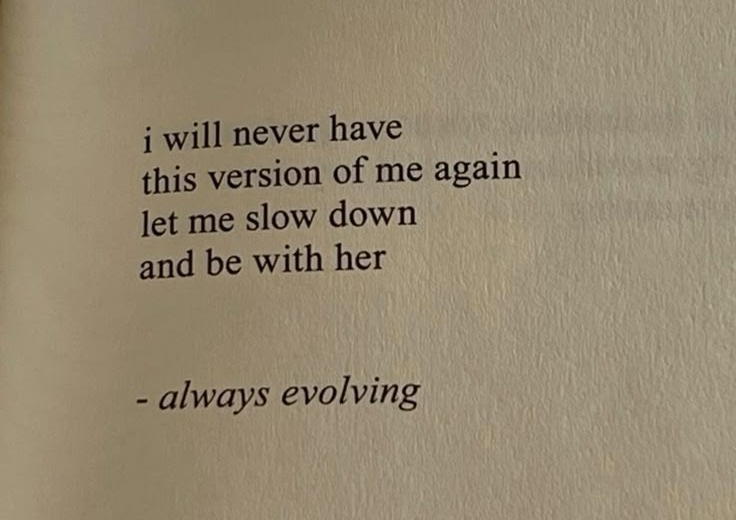
Here’s the thing nobody bothered to tell me: no matter how well you know yourself at sixteen, you will inevitably spend your twenties being reintroduced to yourself over and over and over again. You’ll lose touch with yourself, passing ships in the night, missed calls and rusty hinges and dusty shelves. You will find yourself again in new places, somewhere you didn’t expect, someone you don’t recognize. You can take that shortcut, following the road less travelled by, but you will inevitably wander off the path, getting side-tracked, still just as lost as anybody else. Because no matter how much you feel like you are a real person at twenty, that version of you will not exist by twenty-two. And that iteration of you at twenty-two will disappear by twenty-five. And at twenty-six you’ll wonder if you ever even knew yourself at all. And by twenty-eight you will spend twelve months desperately trying to find yourself, even though you found yourself seven different times in half a dozen different places in the last decade.
With every passing year, I find myself thinking, Surely I’ve done it, surely now I’m actually fully-formed. And with every passing year, I am rudely awakened to the reality that no, this is just life, you are never fully-formed. And that’s terrifying, but it’s also kind of incredible. That for all the times you think you know yourself, there is always the chance to change, to become someone new, to learn something that alters the way you walk in the world.

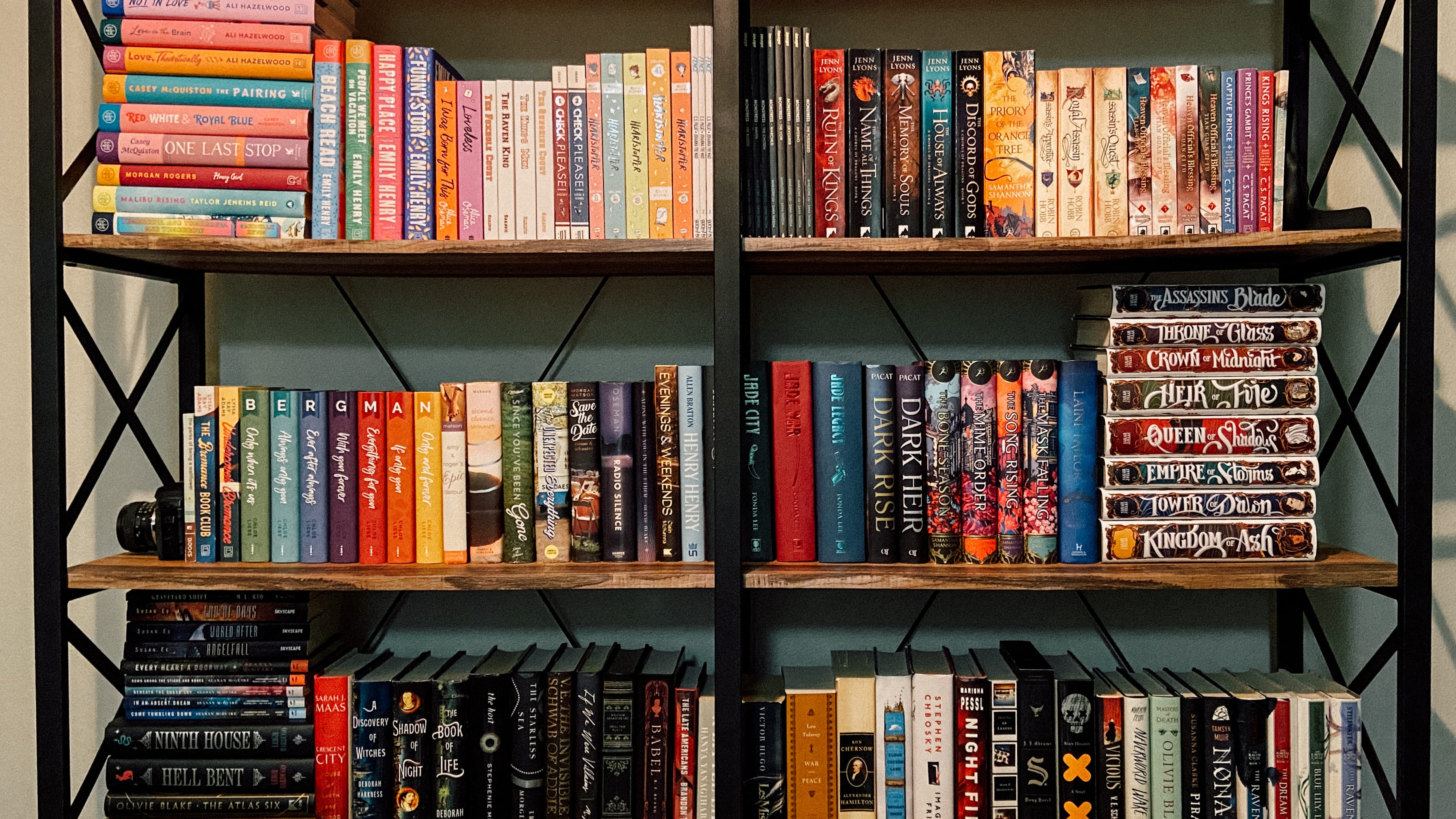
This is most apparent in how my taste in books has developed as I age.
Throughout my twenties I’ve spent hours and hours dissecting my interests, my favorite things, my core-self, in the hopes that I can map my soul on a piece of paper. If I have a list of books that have shaped me, then I can point to some words and characters and themes and say YES, THIS IS ME, I’VE FINALLY CRACKED THE CASE. I can prove that I’m a real person. I can show someone else exactly where the universe intersected to create ME.
And yet, every time I create a list like this, I know that I’m crafting a time-bomb. That list has an expiration date. Perhaps it will expire next week when I discover a new favorite book. Maybe it will be 86’d in a few years when I look back and realize, Oh, that book doesn’t resonate with me anymore. But no matter whether the list is dead or alive, real or fake, static or dynamic, it serves a purpose: to immortalize who I was and what I valued at this moment in time.
I document myself so intensely because our selves are fleeting. You can screenshot some text messages or save a photo to your hard drive, and that moment will exist forever, but how do you archive who you are in this moment? How do you show someone who didn’t know you then, just who you were at twenty-seven if you cannot photograph your soul?
You have to piece together a SELF through notes and voice memos and self-portraits and favorites lists.
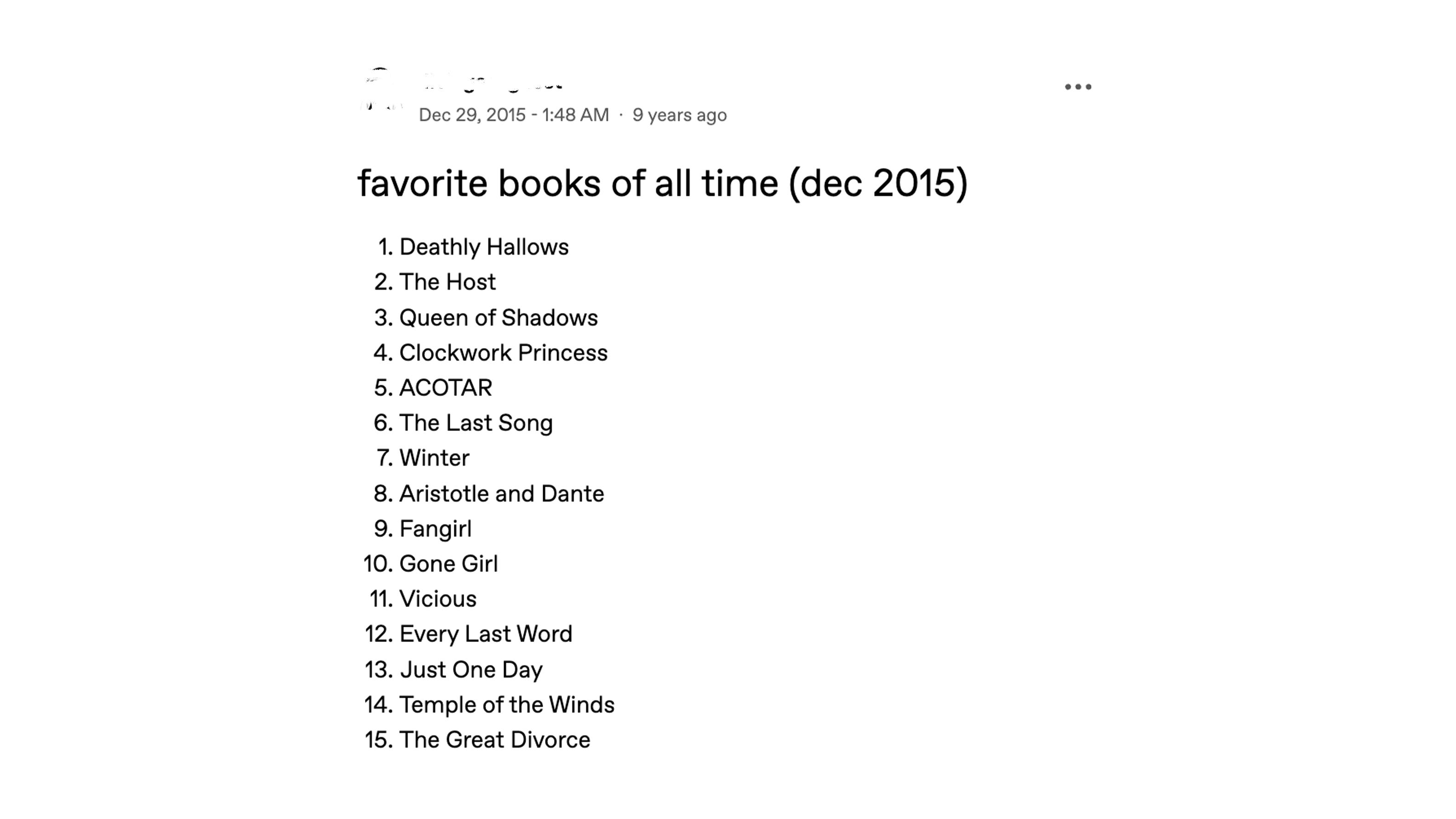
It’s fun to look back on these lists over the years - whether it’s past playlists or a list of movie recommendations or a YouTube video of my favorite books - not only because it feels like a time capsule, but because it shows just how much I’ve changed over time. Some pieces of media stand the test of time. I still reread The Hunger Games and think about being thirteen, waiting to walk into Barnes & Noble to buy Catching Fire on release day. I still listen to the Kim Possible soundtrack and sing every word, like the Christmas I got it on CD in 2003. But often when I rewatch old videos of myself talking about the books I read in a given year, I’ll stare at the screen and think, THIS is the book you ranked above all others? THIS is the story that shaped you at age twenty-one? I remember choosing that book, I remember the feelings that I felt, but the more time passes, the more it starts to slip away. The more I judge the person I used to be.
I’ve read upwards of 700 unique books so far in this life according to Goodreads - that’s roughly 40 new books a year if we start counting at age 13 - and you’d think with a number that large, I’d feel more confident in my taste. That my favorites list or my “books read” list would be mature and ADULT, innovative and intelligent and creative and cool. But I wasn’t a real person until a few weeks ago. Just yesterday, actually. So most of those books are dated and cringe and young and frivolous. Looking back on my READ shelf on Goodreads sometimes feels like looking through photos of yourself from middle school: a little endearing and a lot embarrassing.
Maybe that’s because a lot of the books I’ve read are by white authors. Maybe it’s because most of my favorite books revolve around fictional characters and magic and romance. Maybe I just don’t read a lot of intellectual, “adult” books. Maybe I just read the same six books over and over again.
For as much as I like to pretend I’m a cool person, someone who has taste, I am realizing that I never really outgrew the cringey thirteen-year-old I used to be. There’s nothing wrong with being twenty-two and enjoying a book about faeries. There’s no shame in finding joy in bad poetry. There’s no problem with being twenty-nine and reading your favorite series about a fictional sport for the seventh time. Reading is a hobby, reading is self-discovery, reading is entertainment as much as it’s a learning experience. And I think people discount all the things you can learn from fiction. From toxic characters. From books that explore sexuality and romance and partnership.
With the rise of BookTok especially, people have developed this ridiculous notion that there’s a right and wrong way to read. And sure, I do think skipping entire paragraphs or only reading dialogue is the wrong way to read, but your personal taste in books is not a marker of status or intelligence. I’m still going to judge you if you exclusively read monster romances, but hey, it’s your prerogative.
So why do I feel so ashamed of my favorite books from my youth? Why do I still find shame in the books I love now? That’s like asking why do I hate my younger self so much. I think we’re just programmed to feel shame about joy. We have a difficult time looking back on our past with love, and we cannot forgive our younger selves for not knowing what we know now.
That said, there are books that don’t resonate with me anymore. Sometimes that comes down to how I’ve changed, that I enjoy more mature content or I’m more attuned to bad writing or harmful content, but sometimes it’s about how the world has changed. Authors who’ve been publishing for a long time can lose their magic or even lose their humanity. Concepts and theories from one time period can become outdated within a few years or decades. Tropes that once were popular can quickly become overdone and annoying, like a song that goes viral. The more we learn, the more we grow, the more we know. And sometimes the more you know, the less you can enjoy things. Ignorance is bliss or so they say.
But you can’t reason with the brain. This is why taste is so fascinating. I admit that some of my favorite books are bad. Poorly written, a little insensitive, a lot problematic. I can acknowledge that and still find joy in them. I can be multi-dimensional. My taste in books does not dictate whether I am a good or bad person. (I know that’s hard to believe, but it’s the truth.) My taste makes me who I am. The good things I can find in the bad content explain my inner self way more than the classics I’ve enjoyed. And the books that resonated with me when I was younger, whether that’s ten years ago or two weeks ago, are proof that I’ve grown as a person. It’s a simple way to map how my brain has changed.
I’ve tried to be more active in the last five years when picking which books to read. I read more backlisted titles, more diverse titles, more non-fiction titles. Not to prove status or superiority, but to learn more. To grow more. To find new kinds of joy. And maybe it’s because I’m older now, more experienced or more selective, but I find that my list of favorites books is starting to take a particular shape. My actual favorites are more constant, and the things I pick up have started to fit into patterns. They have common themes running through them. The map is finally starting to reveal me as a real person with adult tastes and adult interests and adult discipline. But on top of that, there are still books from my past that I can’t let go.
I’m in a season of my life where I have to find the balance between honoring both an older, more mature version of myself that I’m meeting in the present and chasing after in the future and the whimsical inner child that I carry with me from my past.
Florence says “You can’t carry it with you if you want to survive,”2 but there are some things that you drag behind you like an anchor, stories that cling to you like memorials, and that’s a good thing. These are the pieces of you that shape you in the future. These are the parts of you that make you you. Your pain, your joy, your fear, your dreams. By holding on to your younger self, you are keeping them alive. And that gets harder and harder to do when you age.
(Am I talking nonsense? I feel like I’m talking nonsense.3)
I guess what I’m saying is, I finally feel confident in listing my favorite books. I finally feel like I’ve developed a list of themes and motifs that explain who I am, what I want, and what I fear. I finally feel like a real person. I FINALLY FEEL LIKE A REAL PERSON! After almost thirty years! Wow!
Okay, so I’m not quite ready to give you my top twenty of all-time or whatever, but I can give you a little web of stories that have shaped me. I can show you how my brain connects. And in true Jenna fashion, I went above and beyond to create something so convoluted and complicated for something that should be simple and fun. (Well, this is my fun!!!!!)
Presenting, my map of stories!
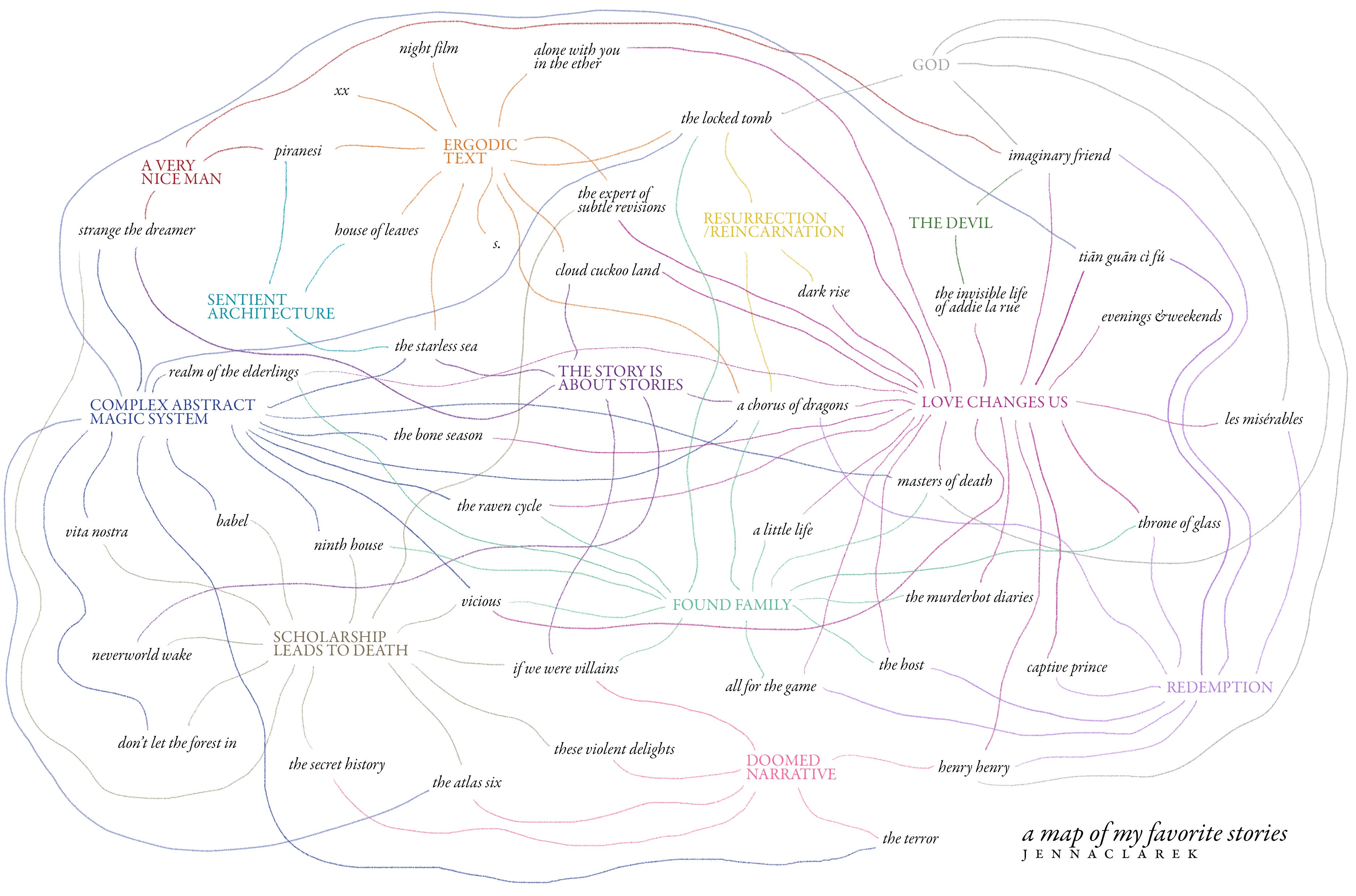
Recently I’ve been stewing in my favorites list again, reflecting on taste and looking at where the last reading year has taken me. I wanted to see where the themes of my favorite books intersect, in the hopes of both finding new books to add to my TBR and seeing where my self intersects with these stories. (Yes, this is a regular Tuesday for me, get on my level.)
Because I’m me, I made a graphic in Photoshop (above), and the neurodivergent part of my intellectual brain is so obsessed with this map. It shows you where a lot of my interests lie - dark academia, ergodic literature, magic - and it shows you some of the books and series that take up the most space in my mind. Some of these stories I’ve had for upwards of ten years, some of them are books I read a few months ago, but almost all of these are books that I think about on a daily basis.
I think it goes to show that we do have recurring themes and concepts in our selves. That certain stories resonate with us more than other because of who we are and what we’ve been through. We all find our joy in different places, and my map of stories is different than yours, but there are so many connections to be made as our taste solidifies throughout our lifetime.
This is by no means a complete list of favorites. I didn’t include a lot of contemporary romance on here. I didn’t include non-fiction. I left out some fantasy that I find really enjoyable. There’s only a smidgen of YA on here. But this feels like a concise list of the books I want to carry with me into adulthood.
And yes, I think it’s quite obvious that my joy comes from reading about how love changes us intrinsically as people.
I’m not gonna try to unravel this crazy web because there are so many strands and threads that overlap and work together, and I do think the map speaks for itself. Even though I wouldn’t put all of these books/series on my all-time favorite books list (the very specific top 20 of singular books that currently reflect my FAVORITE books ever, tbd on that), but they are all stories that speak to my soul. I’ve reread most of them, and the ones I haven’t reread are on my list to reread in the near future. I feel like I could write essays connecting so many of these stories, about how they speak to love and friendship, how they express the power of a good story, how they stress the need for redemption and second changes. (There’s a lot about hubris in there too, I’m sure.) But more than anything, these are stories that I found myself within. They’ve taught me about who I am, who I want to be, and that is everything.
LOVE MOLDS US INTO WHO WE’RE MEANT TO BE
FAMILY IS MADE THROUGH FRIENDSHIP
WE FIND OURSELVES IN STORIES
THE JOURNEY IS SOMETIMES MORE IMPORTANT THAN THE DESTINATION
EVEN A TRAGEDY DESERVES TO BE REMEMBERED
DRAGONS ARE REAL IN CONSEQUENCE
KNOWLEDGE IS A BLOODBATH
EVERYONE DESERVES A SECOND CHANCE
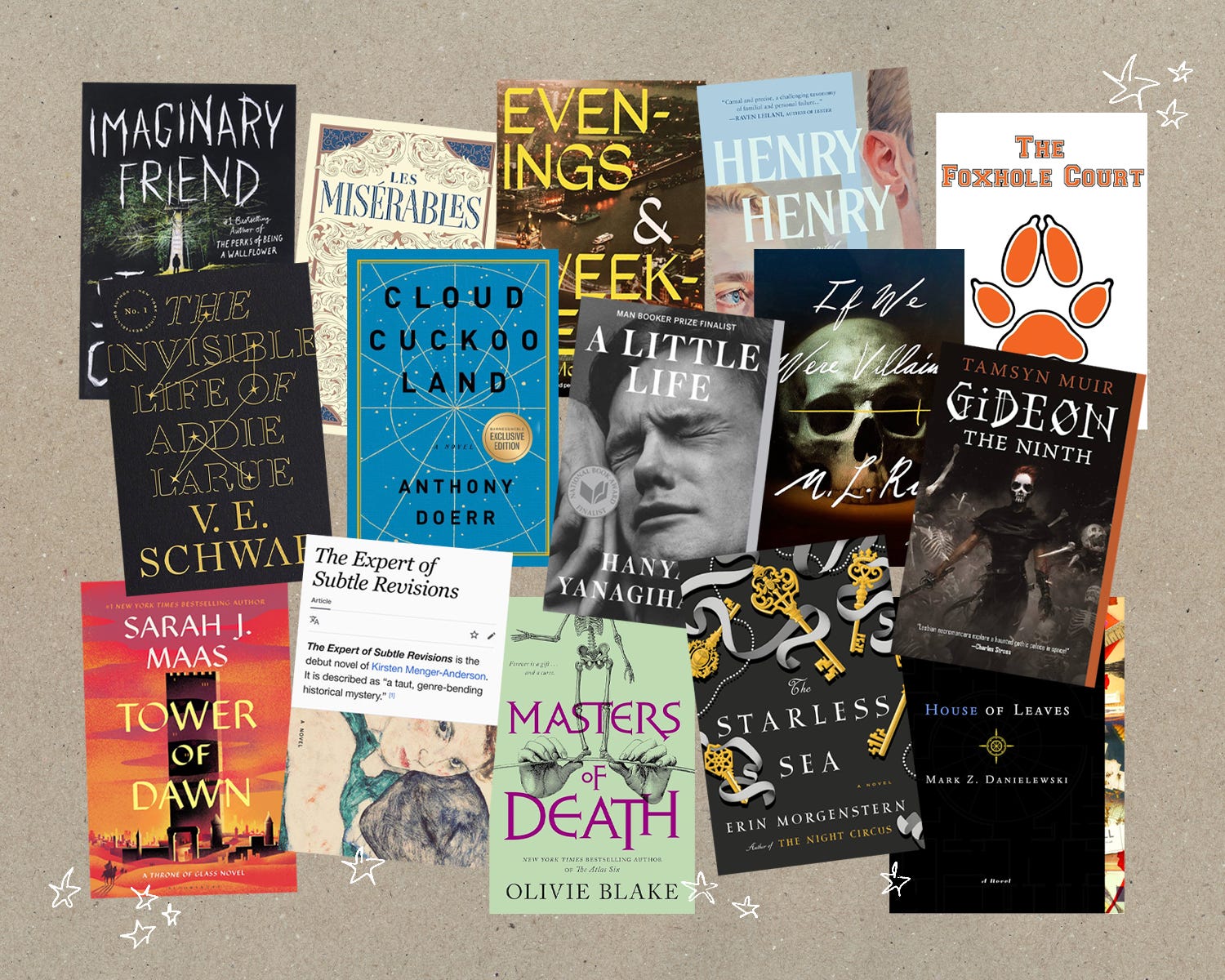
“No,” Willem said, after they’d all stopped laughing. “I know my life’s meaningful because”—and here he stopped, and looked shy, and was silent for a moment before he continued—“because I’m a good friend. I love my friends, and I care about them, and I think I make them happy.” — A Little Life, Hanya Yanagihara
“We are all eaters of souls.” — The Terror, Dan Simmons
“He realizes that the truth is infinitely more complicated, that we are all beautiful even as we are all part of the problem, and that to be a part of the problem is to be human.” — Cloud Cuckoo Land, Anthony Doerr
“To get out, he only needed to look in. Because in was out. To keep power you give it away. It doesn't take violence to kill evil. It takes good.” — Imaginary Friend, Stephen Chbosky
“To live is to be vulnerable. A thin membrane of a soap bubble separates one from impenetrable hell. Ice on the road. The unlucky division of an aging cell. A child picks up a pill from the floor. Words stick to each other, line up, obedient to the great harmony of speech...” — Vita Nostra, Marina Dyachenko
“We're here to wander through other people's stories, searching for our own.” — The Starless Sea, Erin Morgenstern
“Life does not belong to you. It is the apartment you rent. Love without fear, for love is an airplane that carries you to new lands. There is a universe in silence. A tunnel to peace in a scream. Get a good night's sleep. Laugh when you can. You are more magical than you know. Take your advice from the elderly and children. None of it as crucial as you think, but that makes it no less vital. Our lives go on, and on. Look for the breadcrumbs.” — Neverworld Wake, Marisha Pessl
“This experience led me to form a hypothesis: perhaps the wisdom of birds resides, not in the individual, but in the flock, the congregation.”— Piranesi, Susanna Clarke
“We all create stories to protect ourselves.” — House of Leaves, Mark Z. Danielewski
“I don’t even know if I have a “myself.” Maybe I’m just my father, and he’s just his father, and on and on, all the way back to Adam, so no one has ever really died, and no one has ever really lived.” — Henry Henry, Allen Bratton
“A home has a family. A place where someone lives alone is not a home.” — Tian Guan Ci Fu, Mò Xiāng Tóng Xiù
“But this is how you walk to the end of the world. This is how you live forever. Here is one day, and here is the next, and the next, and you take what you can, savor every stolen second, cling to every moment until it's gone.” — The Invisible Life of Addie LaRue, V.E. Schwab
“How can you hold back when you have the chance to do good?” ― Les Miserables, Victor Hugo
“Because maybe, Fox thought with a sudden thunderclap of clarity, maybe it was a choice. To love, to forgive, to lose, to live—it was always a choice, and thus, the fact that he was a mortal was finally one worth celebrating. Because it would end! Maybe that was the entire secret, and therefore the whole thing was actually astonishingly simple. That over and over, he was presented with the same impossible decision—live and suffer, love and grieve—but still, every time, with all his being, his answer was and would always be yes. It would be difficult and painful, and however it ended, it would end—but still, he could choose it. To live, to love; it was always a choice, and inherently a brave one, to face down certain doom with open arms.” — Masters of Death, Olivie Blake
“It’s finished, it’s done. You can’t take loved away.” — Nona the Ninth, Tamsyn Muir
“I wondered if there was any way to live amongst other people and refuse to be harnessed by their expectations and dependencies.” — Assassin’s Quest, Robin Hobb
“Nothing New” by Taylor Swift
“Dog Days Are Over” by Florence + the Machine
makes me think about the time in college when a professor asked us to think about the difference between “what are you?” and “who are you?” …these questions become even more difficult to answer when you realize those answers are not and can never be static!!